
The ACOM Oversight Scale
Schools are adopting different operational approaches to manage staff–student communication in activities and athletics.
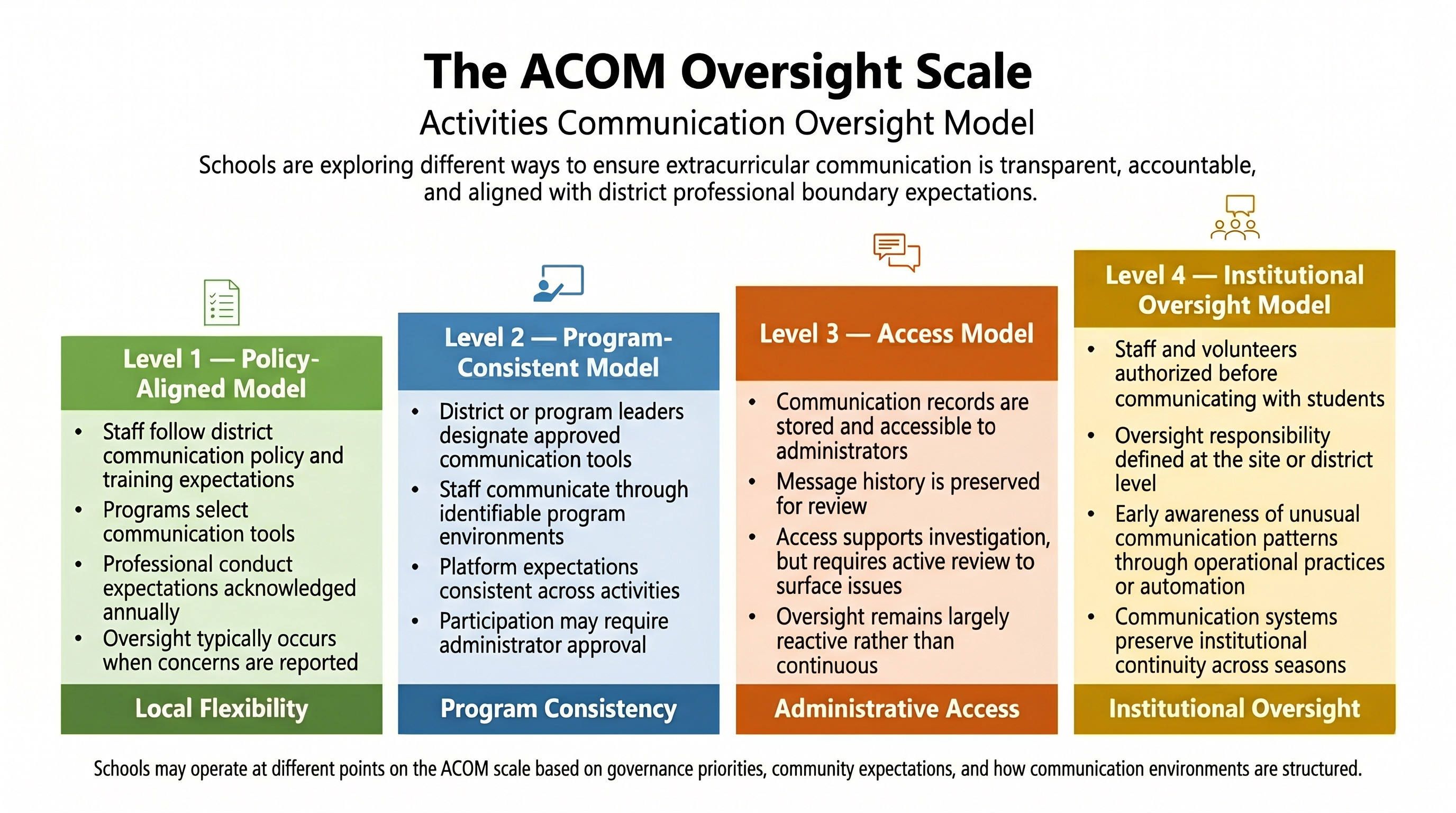
The Activities Communication Oversight Model (ACOM) illustrates these approaches as a progression from policy-based expectations toward communication environments that support institutional transparency and oversight.
Understanding the ACOM Levels
The ACOM scale describes four common governance approaches schools use when managing extracurricular communication.
Level 1 — Policy-Aligned Model
Communication expectations are primarily defined through school policy and staff training.
Programs/teams often select communication tools independently, and professional conduct expectations are reinforced through annual training and acknowledgement. Administrative awareness is limitted and typically occurs when concerns are reported.
Level 2 — Program-Consistent Model
Districts or program leaders designate approved tools for extracurricular communication, creating more consistency across teams and activities.
Staff are expected to use these tools, and communication practices begin to align at the program level rather than varying by individual coach or advisor. Participation may require administrator or program approval.
While communication records may exist, access to those records depends on the capabilities of the platform and how it is used in practice.
Level 3 — Access Model
Communication occurs within environments where administrators have access to stored communication records.
Messages are preserved and can be accessed by administrators or IT without vendor request or download. Shared communication spaces help reduce reliance on private messaging channels.
Access supports investigation when concerns arise.
Level 4 — Institutional Oversight Model
Operational structures support defined authorization, institutional continuity, and early awareness.
Staff and volunteers are authorized before communicating with students, oversight responsibility is defined, and communication environments support awareness of unusual patterns across teams, seasons, and staffing changes. In some cases, schools implement structured review practices or automated flagging mechanisms to help surface potential concerns earlier.
How Common Communication Tools Align to ACOM
Different communication tools support different levels of oversight.
Some rely primarily on policy and staff behavior, while others provide structural capabilities that allow schools to operate more consistent, transparent, and governed communication environments.
The categories below illustrate how common types of tools typically align with the ACOM scale.
The same platform may operate at different points on the ACOM scale depending on how it is configured and used locally.
However, structural capabilities — such as administrative access, message retention, authorization controls, and oversight workflows — determine how reliably a platform can support higher levels of oversight.
Explore Platform Capabilities in Detail
The full comparison below evaluates specific platforms based on the structural capabilities required to support communication oversight — including administrative access, message retention, and governance workflows.
👉 View the full comparison matrix of school communication platforms
.svg)


